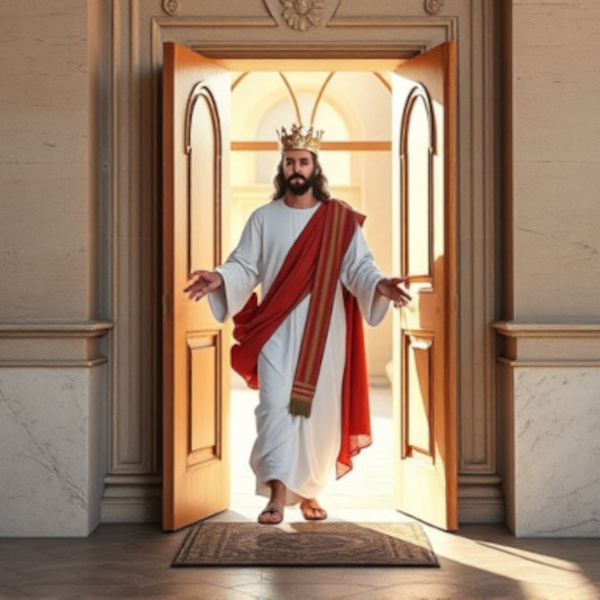
Many people pray “Thy kingdom come, Thy will be done” routinely, without much thought as to what it means. It means, first of all, “Be my King,” which means, “Tell me what to do, make it possible for me to obey, and I’ll do it.” And then, “From now on, whenever my will conflicts with Yours, let Yours, not mine, be done.”
Put that way, it can sound a little scary. Well, more than a little scary: Luke tells us that even Jesus, on the eve of His crucifixion, sweated blood over it (Luke 22:41-44). But consider: We all have to die at some time or other, and if we are on good terms with our heavenly King, we can ask Him for whatever deathbed comforts might make our passage out of this world tolerable. And because He loves us, and is almighty, and is the Cleverest and Kindest Person Ever, you may expect Him to do it. If you doubt that He is all these things, ask Him to convince you. He can.
O.K., that is the hardest part. Then there is that secret vice of yours. George Fox wrote in 1652, “Whatever ye are addicted to, the Tempter will come in that thing” (Epistle No. 10, in Works, v. 7, p. 20). “Oh, no!” you may cry. “Does that mean I’ll have to give up that?” Again, if God is your King, He will find the best and easiest way to conquer your pet addiction. And He may also show you that it is not your worst vice! Let me ask: Do you secretly curse people who have hurt you? Or do you laugh at cruel jokes about the kind of people you hold in scorn? Let Him cure you of your unforgiveness and your “othering.” These traits mar your perfect beauty in His eyes.
For God loves perfect beauty. And that is why He made a beautiful creation, and then made human beings in His own image and likeness (Genesis 1:26), with a love of beauty, and a delight in sharing it, just like His own. (Think: Why did God give us color vision rather than black-and-white, and such a love of music?)
Now perhaps, if you grew up in the United States, you were raised with a distrust of kings and kingship, especially if the word “king” conjures up the image of a straight white male bully with a lot of human flaws. (And please forgive me for having been one myself; I am asking my King to wash me clean of all such bullying, arrogance, and selfishness.)
But about kings: According to Scripture, when the Lord spoke to Samuel in 1 Samuel 8:7-9, He did not say “Kingship is a stupid idea,” but “They have not rejected you, Samuel, but they have rejected me, that I should not rule over them.” In fact, God had been King over Adam and Eve once; but then they decided to experiment with liberal democracy, where “everyone did as he saw fit” (Judges 21:25). And what their choice brought them was death—preceded by a life of pain, fear, ignorance, and “othering.” Yes: the first thing Adam did after they were caught was to blame Eve—to “other” her.
This is not to speak ill of liberal democracy, but democracy, just like monarchy among fallen humans, can only promote the common good to the extent that neighbors love neighbors as themselves. As for loveless Christendom’s historical associations with loveless monarchy, with its wars, enslavements, and genocides, I like to think of myself as a follower of George Fox, who regarded the weaponization of the Christian Church by Emperor Constantine (306-337) as just another chapter in the long history of the Church’s “apostasy” from the gentle, forgiving Spirit of Christ. Yes, just as Adam and Eve’s progeny had grown ever more distant from their Creator’s goodness with each generation, so had the progeny of Jesus Christ’s first flock.
But Christ had now come, in Fox’s words, “to teach His people Himself.” Or rather, as the early Friends discovered, He had always been there, indwelling us as the Light in our conscience, encouraging the good and reproving the evil in all human beings. And in that self-revelation, Fox held, Christ would also resume His rightful office as our King—if only we would invite Him to!
For Scripture rightly tells us (Rev. 3:20) that He stands at our door, knocking for admission. I, who had squandered decades of my life half-pursuing “enlightenment,” heard from the Holy Spirit, as I turned 45, “Not enlightenment—obedience!” And two years later, after mentally laying self-will down on His altar and asking His help to thenceforth live in accordance with His will always, I began to be rewarded with manifestations of His likeness before my mind’s eye, His voice in my inward ear, and His palpable guidance in quandaries. Now 82, I count myself a sinner-in-recovery whom my King has never asked to do the impossible. Oh, fellow sinner, do you hear Him knocking? Do let Him in.
John Jeremiah Edminster, Stillwater (OYM), 11/2025
